

Vacuum systems
Central Vacuum vs. Robot Vacuums: How They Work Together
The most advanced, low-maintenance properties aren’t choosing between a central vacuum and a robot vacuum—they are integrating both systems into one cleaning ecosystem.
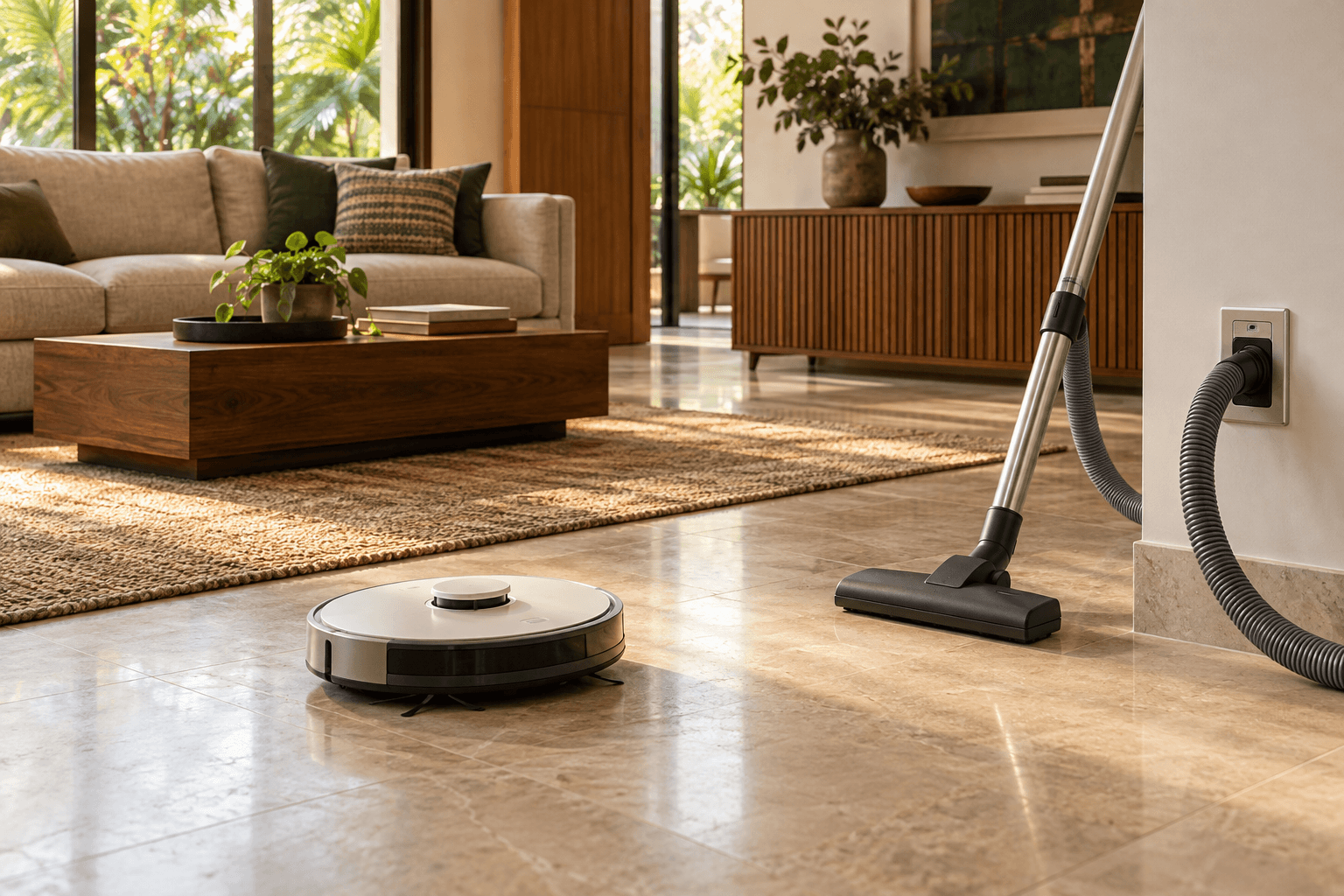
For years, the home cleaning market has been framed as a battlefield. In one corner, you have the traditionalists championing the deep-cleaning muscle of a central vacuum system. In the other, you have tech enthusiasts praising the “set-it-and-forget-it” convenience of autonomous robot vacuums.
As we design and build smart homes, the verdict is in: It was never a competition.
The most advanced, low-maintenance properties aren’t choosing between the two—they are integrating both systems into a unified, high-performance cleaning ecosystem. Here is why a smart home needs both a central vacuum and a robot vacuum to achieve indoor wellness and convenience.
1. The Dynamic Duo: Maintenance vs. Deep Cleaning
To understand why you need both systems, it helps to understand the fundamental difference in their roles.
- Robot Vacuums are for Maintenance. They are excellent at surface-level upkeep. A robot vacuum can run daily to sweep up pet hair, crumbs, and surface dust from your main thoroughfares. They keep the home looking visibly clean on a day-to-day basis.
- Central Vacuums are for Deep Cleaning. A robot vacuum simply doesn’t have the suction power or the capacity to deep-clean plush carpets, upholstery, baseboards, or ceiling vents. Central vacuums utilize massive, stationary motors located in the garage or basement, providing up to five times the suction power of a portable or robotic unit.
By pairing them, your robot keeps the floors tidy throughout the week, while your central vacuum makes your weekly or bi-weekly deep cleans incredibly fast and thorough.
2. The Integration: Auto-Emptying “Motherships”
The useful change is how these two technologies physically connect.
Historically, the main annoyance of a robot vacuum was its tiny dust bin. Even “auto-empty” robot bases require you to change out a small disposable bag every few weeks, and those bases can be loud and unsightly in your living space.
Smart home installers are connecting robot vacuum docks directly to the central vacuum lines.
When the robot docks, the central vacuum system automatically triggers, instantly sucking the debris out of the robot and sending it through the walls straight to the main canister in the garage. This means your robot vacuum can operate for months or even a full year without you ever having to empty a single thing.
3. The Indoor Air Quality (IAQ) Factor
Indoor air health has become a massive priority for modern homeowners. Portable vacuums and standalone robot vacuums—even those equipped with HEPA filters—have an inherent flaw: they exhaust air right back into the room they are cleaning. This process can kick fine dust particles, allergens, and dander back into the air currents before the filter can catch them.
A central vacuum handles airflow completely differently:
- Zero Recirculation: It pulls 100% of the dirt, dust, and microscopic allergens out of the living space entirely.
- External Exhaust: The air travels through hidden tubing in the walls and is exhausted outside the home or into an isolated garage space.
By relying on your central vacuum for heavy cleaning, you ensure that the air your family breathes is completely free of recirculated dust.
4. The “Hide-A-Hose” Revolution
If your memory of a central vacuum involves dragging a bulky, 30-foot plastic hose out of a hallway closet, it’s time for an update.
Current installations use Hide-A-Hose (retractable hose) technology. The vacuum hose is stored inside the actual wall piping. You simply open a sleek wall inlet panel, pull out the exact length of hose you need, lock it in place, and vacuum. When you’re finished, the sheer suction power of the central vacuum pulls the hose smoothly back into the wall, completely out of sight.
Combined with VacPan toe-kicks in the kitchen or mudroom—where you can simply sweep debris toward a floor vent and watch it disappear—the central vacuum has become just as frictionless as its robotic counterpart.
5. Maximizing Resale Value and Appliance Lifespan
Investing in a central vacuum system is an investment in the structural infrastructure of your property, much like upgrading an HVAC system. It increases your home’s equity and appeals heavily to future buyers.
Furthermore, using a central vacuum for your heavy-duty cleaning dramatically extends the lifespan of your robot vacuum. Because the robot isn’t constantly straining its small motor against dense carpets or heavy dirt loads, its battery and mechanics last years longer.
Conclusion
Relying solely on a robot vacuum is like only using a dustpan; relying solely on an old-school vacuum is an unnecessary chore. True smart luxury is found in the synergy between autonomous maintenance and raw structural power. By integrating a central vacuum system with your smart robotics, you create a self-sustaining clean home that saves you time, protects your health, and preserves your property.